
- Share
- Share on Facebook
- Share on LinkedIn
Communiqué / Team S.Carnicella, Research
On August 19, 2026
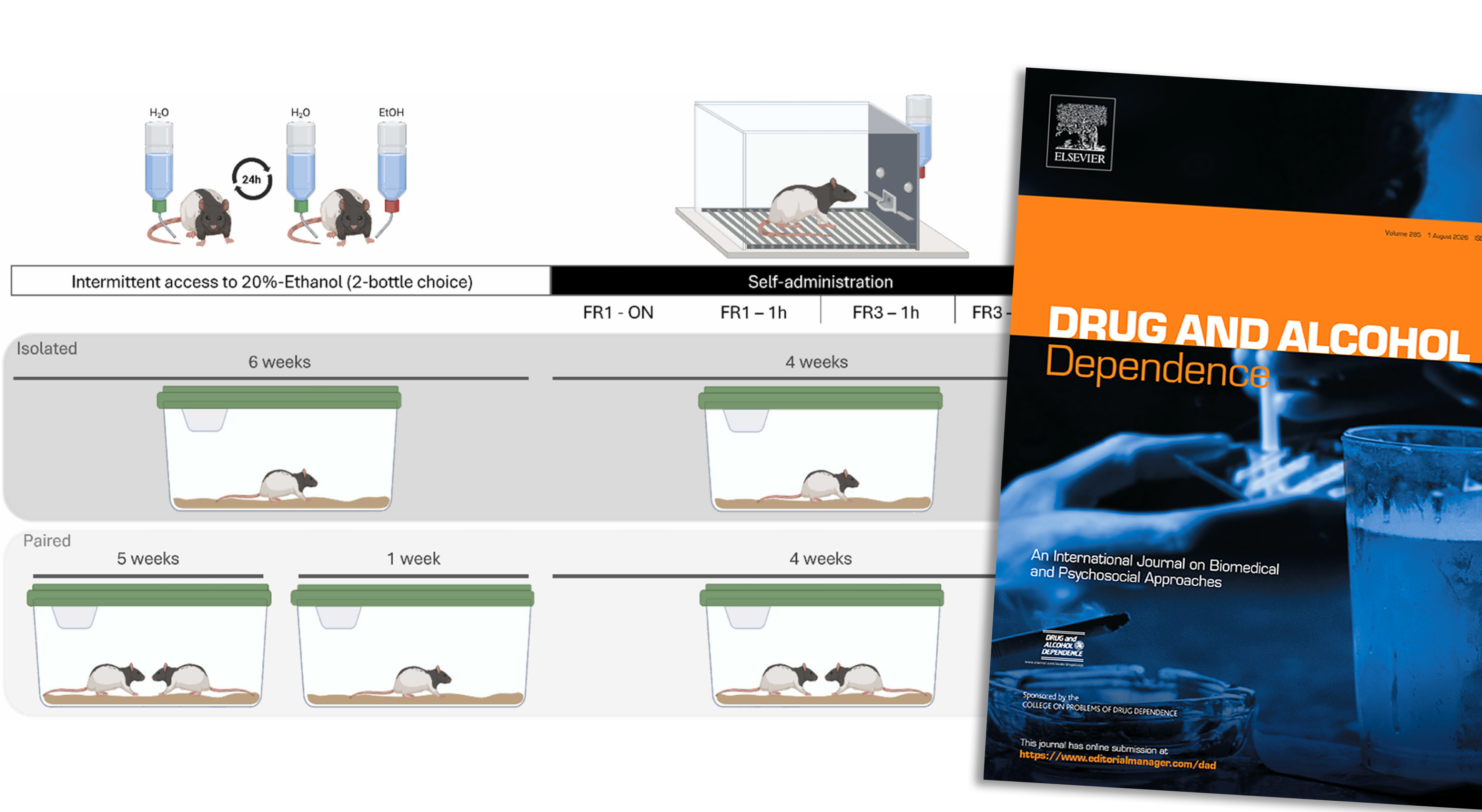
In preclinical research on alcohol addiction, rats are often housed alone. A team from the Grenoble Institute of Neurosciences investigated whether they could be housed in pairs without compromising the validity of the experimental model. Their findings reveal a more complex picture than might be expected.
Rats are social animals. Yet in many preclinical studies of alcohol use disorder, they are housed individually so that researchers can monitor each animal’s alcohol consumption.
Although this practice makes measurements easier, it also raises both ethical and scientific questions: how does isolation affect the animals’ welfare and behaviour? Could it be avoided by housing rats in pairs without compromising the reliability of the results?
This is what Cécile Gaudart and Mylène Wilt, PhD students in the “Pathophysiology of Motivation” team at the Grenoble Institute of Neurosciences, set out to determine.
“Our initial objective was to assess whether individual housing could be avoided in this type of experiment,” explains Mylène Wilt. “But we soon found that housing conditions were also a scientific variable in their own right.”
Drinking alcohol or working to obtain it
The researchers compared the behaviour of male and female Long-Evans rats housed either individually or in pairs. The animals were first given intermittent access to alcohol: during these periods, they could freely choose between water and an alcohol solution.
During this initial phase, the researchers found that rats housed in pairs consumed approximately the same amount of alcohol overall as individually housed animals.
“The fact that they consume similar amounts of alcohol does not necessarily mean that their behaviour is driven by the same mechanisms,” Mylène Wilt points out. The presence or absence of another rat may influence their behaviour in different ways.
The animals were then placed in a self-administration setting: to receive alcohol, they had to press a lever. This task makes it possible to study not only alcohol consumption, but also the animal’s motivation to obtain it.
During this second phase, rats housed in pairs consumed less alcohol than individually housed animals. They therefore showed less motivation to obtain alcohol.
Comparing the two phases reveals that housing conditions do not have the same effects depending on how alcohol is made available. “Our findings show that drinking freely available alcohol and making an effort to obtain it are not driven by the same processes,” Mylène Wilt explains.
The social environment as an experimental variable
“Pair housing cannot therefore systematically replace individual housing,” concludes Cécile Gaudart. “Its use must be assessed according to the experimental protocol and what researchers are seeking to investigate: alcohol consumption or the motivation to obtain alcohol.”
The issue remains complex, however. In humans, several studies have identified an association between social isolation or feelings of loneliness and problematic alcohol or other substance use. Although individual housing removes rats from their usual living conditions, it may therefore also help researchers study the potential influence of this vulnerability factor.
Towards a better understanding of the effects of isolation
Since pair housing cannot systematically replace individual housing, further questions arise: what are the actual effects of isolation on rats’ behaviour and welfare, and how can these effects be mitigated?
These questions lie at the heart of the EDHOSI2HAR project, led by Colin Deransart and recently awarded funding by the French GIS FC3R. The project will assess the consequences of individual housing in rats and determine whether daily handling can help mitigate them.
Reference :
Impact of paired-housing on a preclinical model of alcohol use disorder
Cécile Gaudart, Mylène Wilt, Fanny Joly, Raphaël Goutaudier, Colin Deransart, Yvan M. Vachez, Sebastien Carnicella
Drug and Alcohol Dependence, Volume 287, 2026.
https://doi.org/10.1016/j.drugalcdep.2026.113289.
Date
Refining practices without using additional animals
To conduct this study without creating a new control group of individually housed animals, the team reused data from several cohorts studied in the laboratory over previous years. Using a statistical resampling method, the researchers were able to compare groups of equal size.
This approach addresses two of the principles governing animal research: Refinement, by seeking to improve housing conditions, and Reduction, by limiting the number of animals used.
- Share
- Share on Facebook
- Share on LinkedIn