
- Share
- Share on Facebook
- Share on LinkedIn
Communiqué / Team J.Bastin, Research
On September 24, 2026
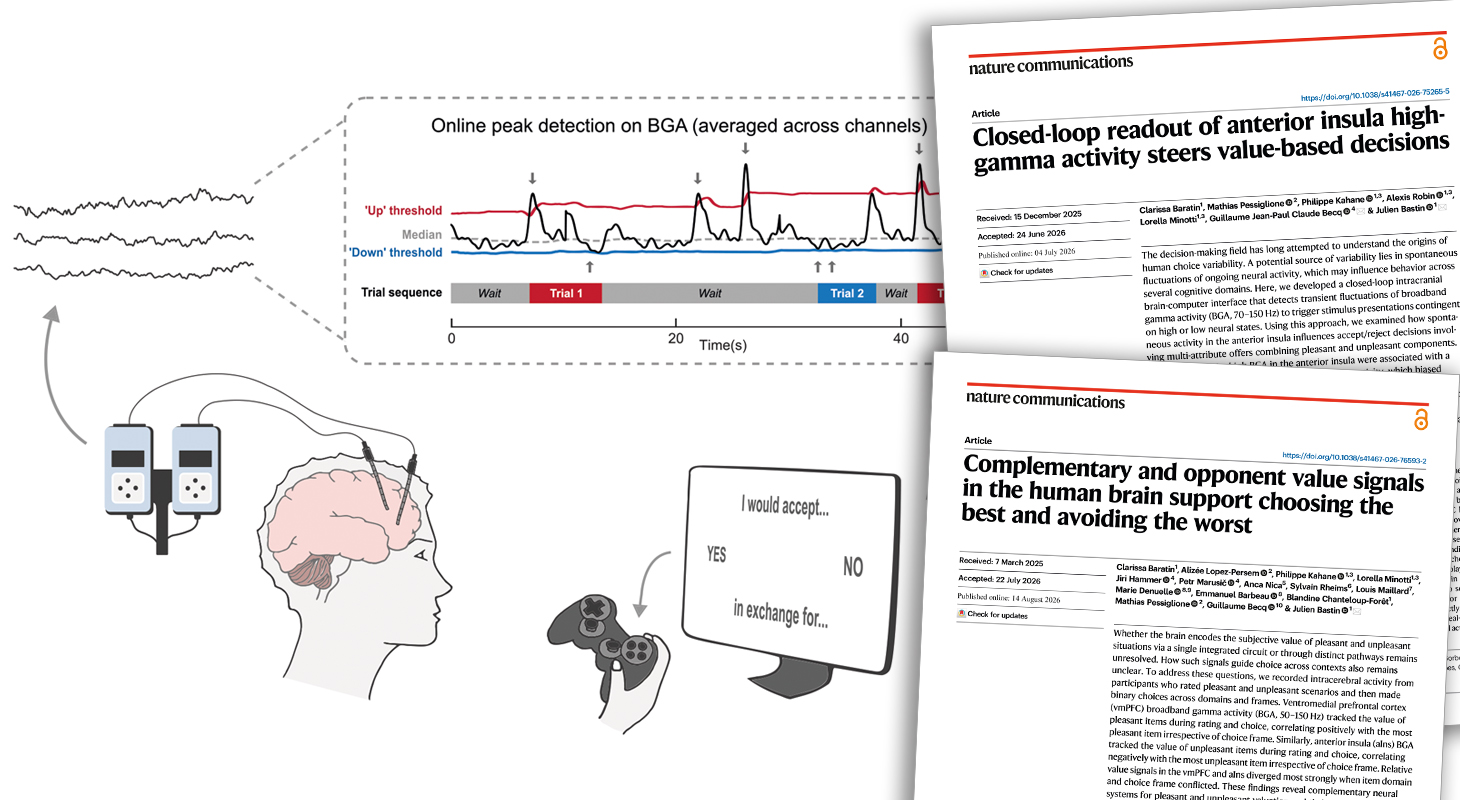
Two studies conducted at the Grenoble Institute of Neuroscience as part of Clarissa Baratin’s PhD research and published in Nature Communications show that our brain does not rely on exactly the same neural circuits to evaluate pleasant and unpleasant experiences, and that its activity immediately before a decision can influence our choices.
The brain does not process “I like” and “I don’t like” in the same way
Choosing between two dishes, accepting or declining an invitation, taking the lift or the stairs: our decisions depend in part on the value we assign to the different options available to us. But does our brain use the same scale to evaluate what we like and what we dislike?
“We can imagine a line with ‘I don’t like’ on the left and ‘I like’ on the right. The prevailing hypothesis is that there is a system in the brain that encodes value along this continuum. But other studies suggest that pleasant and unpleasant values may be processed by separate systems,” explains Julien Bastin, a researcher at the Grenoble Institute of Neuroscience who supervised Clarissa Baratin’s PhD.
Twenty-seven people with drug-resistant epilepsy who had been implanted with intracranial electrodes as part of their clinical care at Grenoble University Hospital agreed to take part in a study exploring this question.
They first rated 240 hypothetical situations: 120 pleasant ones, such as admiring a beautiful sunset or eating a slice of cake, and 120 unpleasant ones, such as being cold outside or tripping in public.
Participants were then asked to make different choices between two situations: selecting the best or worst of two pleasant options, and then the best or worst of two unpleasant options. This experimental design notably allowed the researchers to distinguish the value assigned to a situation from the instructions given to the participant.
Two complementary systems for evaluating what is pleasant or unpleasant
Analysis of the participants’ intracranial recordings showed that brain activity varied differently in response to pleasant and unpleasant situations.
In the ventromedial prefrontal cortex, broadband gamma activity preferentially tracked the value of pleasant situations: it increased with the value of the most highly rated option. In the anterior insula, by contrast, this activity preferentially reflected the value of unpleasant situations.
“What our results suggest is that there may be one system that processes value in the pleasant domain,‘I like it a lot’ versus ‘I like it less’ and another that evaluates how unpleasant, or conversely how tolerable, an unpleasant situation is” explains Julien Bastin.
This preferential sensitivity of the ventromedial prefrontal cortex and anterior insula persisted regardless of the instructions given to participants: whether they were asked to choose the best or the worst of the two options.
Listening to the brain before the choice even appears
Having identified the roles of the ventromedial prefrontal cortex and anterior insula in evaluating the options presented to us, the researchers turned to another characteristic of our decisions: their variability.
“In real life, we may make different choices at different times. So we asked ourselves where this variability comes from: does it depend solely on what we are offered, or can the state of the brain immediately before a choice also play a role?” explains Julien Bastin.
To find out, the team developed a closed-loop intracranial brain–computer interface. In twelve people with drug-resistant epilepsy, the researchers recorded broadband gamma activity in real time, an electrophysiological signal associated with the local activity of neuronal populations. The computer automatically detected moments when this activity was particularly high or low in the anterior insula or ventromedial prefrontal cortex. Detecting one of these states then triggered the appearance of an offer on the screen.
“Basically, it’s as if we were ‘streaming’ brain activity: we listen to it in real time and ask the person to make a decision when the activity is high or low,” explains Julien Bastin.
As in the first study, participants had first rated 240 pleasant or unpleasant situations. They were then asked to decide whether to accept or reject offers combining one positive and one negative element. Most of these offers were deliberately selected around each participant’s point of indifference, meaning that acceptance and rejection were approximately equally likely. Crucially, participants were unaware that the timing of each offer was directly determined by their own brain activity.
A few hundred milliseconds that can influence a choice
It was in the anterior insula, already identified in the first study as being particularly sensitive to the unpleasant dimension of situations,that an effect on behaviour was observed. When the presentation of an offer was triggered by high activity in this region, participants were more likely to accept it than when activity was low.
After the offer appeared, this high activity was followed by a transient decrease in insular activity, which was itself associated with a greater likelihood of accepting the offer despite its unpleasant component.
Thanks to the temporal precision of intracranial recordings, the researchers were able to track these changes in activity over extremely short timescales. “We can precisely measure what is happening on the scale of a few millimetres and a few hundred milliseconds, and observe that brief bursts of activity can influence our choices,” says Julien Bastin.
The experiment shows that spontaneous fluctuations in anterior insula activity preceding a decision may contribute to the variability of our choices. By contrast, no significant effect on choice was observed when the experiment was triggered by fluctuations in the ventromedial prefrontal cortex. The authors remain cautious about this result, particularly because of the variability observed between participants.
The brain in real time
Taken together, these two studies further clarify the role of the anterior insula in our decisions: particularly sensitive to the unpleasant dimension of situations, its state of activity immediately before a decision is also associated with the choice that follows.
The second study also demonstrates the value of brain–computer interfaces as research tools. By detecting brain activity states in real time that would be difficult to capture retrospectively, they allow researchers to trigger an experiment at the precise moment when the brain is in the state they wish to investigate.
The team is now extending this research to other dimensions of decision-making and motivation, including trade-offs between effort and reward, and is also using brain stimulation to test more directly the role of the networks involved.
References
Complementary and opponent value signals in the human brain support choosing the best and avoiding the worst
Clarissa Baratin, Alizée Lopez-Persem, Philippe Kahane, Lorella Minotti, Jiri Hammer, Petr Marusič, Anca Nica, Sylvain Rheims, Louis Maillard, Marie Denuelle, Emmanuel Barbeau, Blandine Chanteloup-Forêt, Mathias Pessiglione, Guillaume Becq & Julien Bastin
Nat Commun 17, 9760 (2026).
Closed-loop readout of anterior insula high-gamma activity steers value-based decisions
Clarissa Baratin, Mathias Pessiglione, Philippe Kahane, Alexis Robin, Lorella Minotti, Guillaume Jean-Paul Claude Becq & Julien Bastin
Nature Communications, publié le 4 juillet 2026.
Réseaux cognitifs sous-jacents à la prise de décision basée sur la valeur, thèse de doctorat en neurosciences,
Clarissa Baratin, Université Grenoble Alpes, 2024.
Date
- Share
- Share on Facebook
- Share on LinkedIn