
- Share
- Share on Facebook
- Share on LinkedIn
Communiqué / Team B.Yvert, Innovation
On February 6, 2026
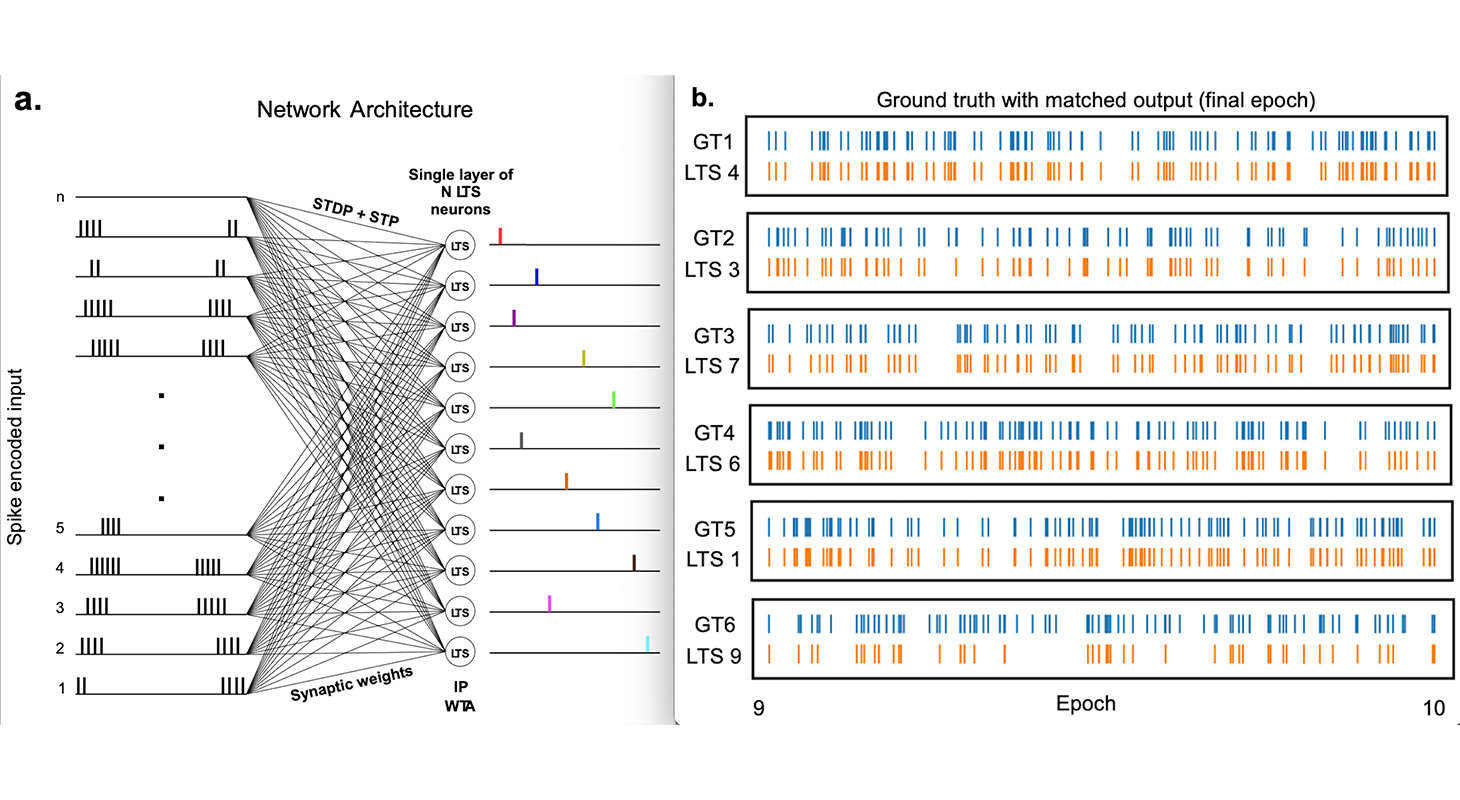
A team from the Grenoble Institute of Neurosciences has developed an extremely simple, biomimetic artificial neural network capable of automatically identifying complex temporal patterns in multichannel neural signals. This original approach offers a solution for real-time processing of the massive data streams generated by next-generation neural interfaces.
Next-generation neural implants integrate hundreds, or even thousands, of electrodes, producing a considerable volume of data.
One of the key steps in exploiting these data is spike sorting, which consists in distinguishing the activity of individual neurons from signals recorded by several neighboring electrodes. Current methods, although often effective, rely on computationally intensive algorithms that are difficult to embed in ultra–low-power implants.
A radically simplified approach
In an article published in Nature Communications, Blaise Yvert and his Neurotechnologies and Network Dynamics team propose a deliberately minimalist spiking neural network (SNN) architecture.
SNNs, considered third-generation artificial neural networks, differ from conventional second-generation deep neural networks in that they incorporate a temporal dynamics that mimics that of real neurons.
While a previously developed architecture from the team enabled the processing of signals from a single electrode using a multilayer attention-based network, this new SNN comprises only a single layer and just a few artificial neurons. Despite its simplicity, it can process multiple signals simultaneously and learn autonomously.
The approach relies on so-called Low-Threshold Spiking (LTS) neurons, whose specific dynamics allow them to “wait” until the end of a temporal pattern before firing. Each neuron in the network thus learns to recognize a specific pattern within a multichannel data stream, without prior knowledge or supervised learning.
Learning is achieved using local rules inspired by biological synaptic plasticity, which drastically limits memory usage, computational cost, and the amount of data required for training.
Performance demonstrated on real data
The algorithm was tested on various types of data, including simulated signals, speech sounds, multichannel neural activity, as well as simulated and real spike-sorting datasets.
In the latter case, the network successfully identifies and automatically classifies action potentials from distinct neurons, achieving performance comparable to certain reference methods, while relying on an architecture compatible with frugal computation.
Toward intelligent, energy-efficient implants
“The idea is to develop algorithms that are sufficiently simple and energy-efficient to eventually be embedded directly into neural implants,” explains Blaise Yvert.
Although the results presented here are still based on simulations, this approach is natively compatible with neuromorphic chips, which are specifically designed to run spiking neural networks at very low power consumption.
Ultimately, this type of algorithm could make it possible to process and select information directly at the source, close to the brain itself, thereby considerably reducing the amount of data that needs to be transmitted and paving the way for more intelligent neural implants that integrate not only signal acquisition but also the automatic extraction of their most relevant features.
Reference:
A frugal Spiking Neural Network for unsupervised multivariate temporal pattern classification and multichannel spike sorting
Sai Deepesh Pokala, Marie Bernert, Takuya Nanami, Takashi Kohno, Timothée Lévi & Blaise Yvert
Nature Communications vol. 16, Article number: 9218 (2025)
Date
- Share
- Share on Facebook
- Share on LinkedIn