
- Share
- Share on Facebook
- Share on LinkedIn
Communiqué / Parkinson, Team J.Bastin
On September 16, 2026
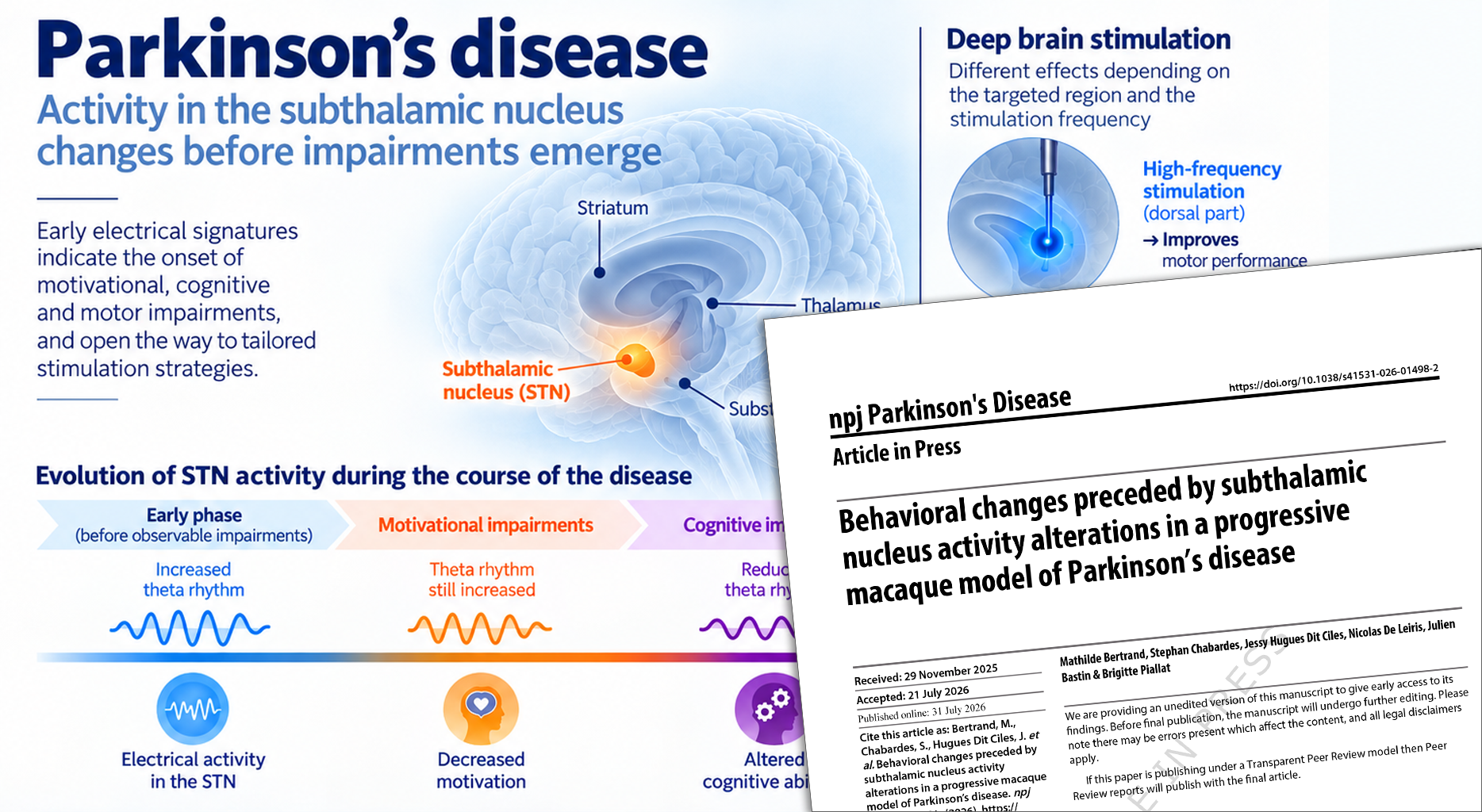
A study conducted at the Grenoble Institute of Neuroscience shows, in a progressive macaque model of Parkinson’s disease, that activity in the subthalamic nucleus changes before the onset of motivational, cognitive and then motor impairments. These findings could pave the way for deep brain stimulation strategies better tailored to each patient’s symptoms.
Parkinson’s disease is primarily known for its motor symptoms, including slowness of movement, rigidity and tremor. However, non-motor symptoms, such as loss of motivation or cognitive difficulties, can emerge well before diagnosis.
Tracking the disease as it develops
To better understand this still poorly understood early phase of the disease, scientists from the GIN’s “Brain, Behavior and Neuromodulation” team followed two macaques over several months as they progressively developed parkinsonian syndrome.
The animals regularly performed a task designed to separately assess their motivation, their ability to adapt their responses and their motor speed. At the same time, electrodes implanted in their subthalamic nucleus recorded the electrical activity of this small brain region. Located within the basal ganglia, the subthalamic nucleus is involved not only in motor control, but also in cognitive and motivational processes.
“The progressive model allowed us to observe how activity in the subthalamic nucleus changes as the disease develops, even before some deficits can be detected,” explains Brigitte Piallat, researcher and lecturer at the Grenoble Institute of Neuroscience and coordinator of the study.
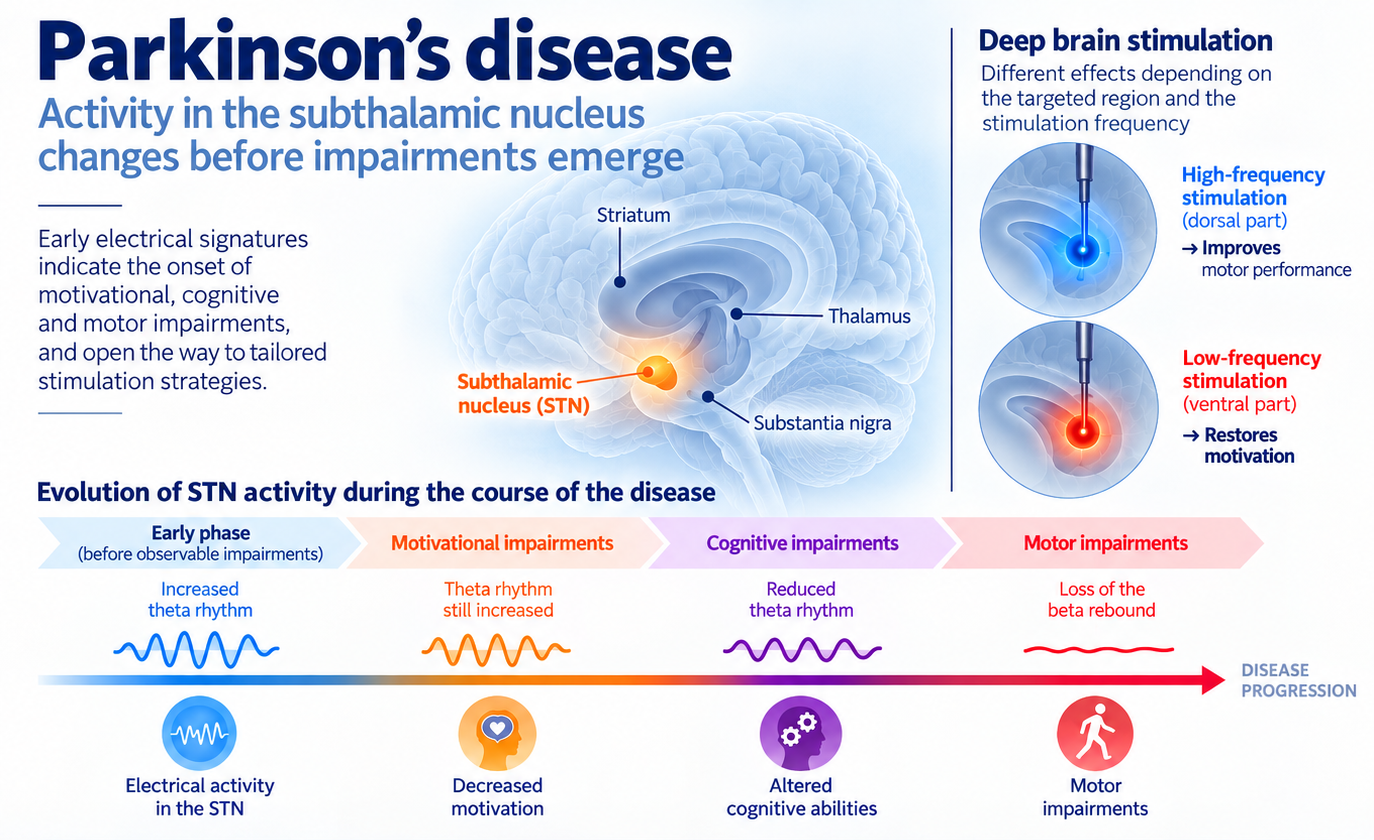
The scientists identified a sequence of changes in brain activity.
While the animals’ behavior was still normal, reward-related activity in the subthalamic nucleus was already altered. A decline in motivation then emerged, followed by cognitive difficulties and, finally, motor impairments.
Each of these stages was associated with specific changes in the electrical activity of the subthalamic nucleus, particularly in the theta frequency band, associated with reward and decision-making, and later in the beta band, which is more closely involved in movement.
“Subthalamic nucleus dysfunction therefore precedes the onset of some impairments. These findings provide important insights into the brain mechanisms that accompany disease progression,” Brigitte Piallat emphasizes.
These observations do not, however, constitute a new tool for early diagnosis. The recordings required implanted electrodes and were carried out in an animal model. Their main contribution is to improve our understanding of the mechanisms at work before motor symptoms emerge.
Tailoring stimulation to different symptoms
In a second part of the study, the scientists investigated the effects of different types of subthalamic nucleus stimulation once the parkinsonian syndrome was established.
Deep brain stimulation involves implanting electrodes in specific brain regions to modulate their electrical activity. In people with Parkinson’s disease, high-frequency stimulation of the dorsal part of the subthalamic nucleus may be used to reduce motor symptoms when medication is no longer sufficient. Its effects on non-motor symptoms, however, remain more limited.
In this study, high-frequency stimulation of the dorsal region improved the animals’ motor performance, as expected. By contrast, low-frequency stimulation of the ventral region restored their motivation to the level measured before the onset of the parkinsonian syndrome.
“The subthalamic nucleus is involved in several components of behavior. Depending on the region targeted and the parameters used, stimulation can therefore have different effects on motor, cognitive or motivational impairments,” explains Brigitte Piallat.
These findings could contribute to the development of more personalized deep brain stimulation strategies. New generations of neurostimulators can modulate different brain regions separately and use multiple stimulation parameters.
“Ultimately, the goal would be to match a stimulation mode to each patient’s symptom profile, in order to address not only motor symptoms but also certain non-motor symptoms,” concludes Brigitte Piallat.
Reference :
Behavioral changes preceded by subthalamic nucleus activity alterations in a progressive macaque model of Parkinson’s disease
Bertrand, M., Chabardes, S., Hugues Dit Ciles, J. et al.
npj Parkinsons Dis. (2026). https://doi.org/10.1038/s41531-026-01498-2
Date
Partners
Published in npj Parkinson’s Disease, this study was conducted by Mathilde Bertrand, Stephan Chabardes, Jessy Hugues Dit Ciles, Nicolas De Leiris, Julien Bastin and Brigitte Piallat. It involved the Grenoble Institute of Neuroscience, Grenoble Alpes University Hospital, Clinatec-CEA Leti, Université Grenoble Alpes and the Nuclear Medicine Department of Grenoble Alpes University Hospital. The study was funded by the French National Research Agency (ANR) and carried out with the support of the IRMaGe platform.
- Share
- Share on Facebook
- Share on LinkedIn