
- Share
- Share on Facebook
- Share on LinkedIn
Séminaire / Eq C.Hébert
On March 5, 2026
Séminaire par Andreas Offenhäusser et Viviana Ricon Montes (Forschungszentrum Jülich, Allemagne)
Neural electrodes are the core components of neuroelectronic devices, enabling the recording and stimulation of neural activity. Our research focuses on two primary areas: (1) the design and characterization of the neuron-electrode interface, and (2) the development of flexible neural interfaces for both in vivo and in vitro applications. Microelectrode arrays (MEAs) are commonly used to bridge the interface between neurons and electronic systems. However, current MEAs face limitations in signal fidelity, precision of neural modulation, and long-term biocompatibility. To address these challenges, we are developing nanomaterial-based MEAs that offer enhanced physical and chemical properties, leading to improved cell-electrode coupling. Specifically, we have engineered a hybrid structure combining vertical nanostraws with nanocavities (Fig.1), enabling stable, non-invasive, and long-term recording at sub-threshold resolution.[1]
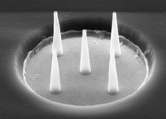
Fig.1 Nanostraw-Microelectrodes for improved recordings from neurons
Implantable neural prosthetic devices provide direct access to local neural circuits and are critical components of brain-machine interfaces. While current clinical-grade devices—typically based on silicon or noble metals—have driven significant advances, they often fail to sustain reliable neural communication over extended periods. Our goal is to create next-generation neurotechnologies that integrate seamlessly with biological tissue, supporting multimodal neural interrogation through electrical, optical, or chemical means. We are actively exploring novel device architectures (Fig.2), materials, and implantation strategies, alongside rigorous performance evaluation, with the ultimate aim of enabling both acute and chronic in vivo applications. Our approach combines thin-film technology and surface micromachining processes with additive manufacturing techniques, including two-photon lithography. These are integrated with self-aligned, template-assisted electrodeposition processes, kirigami-inspired designs with matched-die forming, novel bonding methods, and the modular stacking of two-dimensional neural probes with key-lock systems. These technologies support versatile applications, ranging from investigating seizure-like activity in in vitro epilepsy models to advancing visual prosthesis that enable bidirectional communication along the visual pathway [2,3].
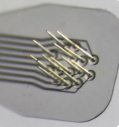
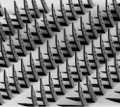
Fig.2 3D printed microelectrodes(top) and Kirigami-Microelectodes (bottom)
[1] P. Shokoohimehr, et al. Small (2022) 18, 2200053.
[2] J. Abu Shihada, M. Jung, et al. Adv. Sci. (2024) 11, 2305944.
[3] M. Jung, J. Abu Shihada, et al. Adv. Mat. 37 (2025)
Andreas Offenhäusser et Viviana Ricon Montes sont invités par Clément Hébert.
Date
11h30
Localisation
Amphi Kampf
- Share
- Share on Facebook
- Share on LinkedIn