
- Share
- Share on Facebook
- Share on LinkedIn
Communiqué / TOC, Research, Team J.Bastin, Team M.Pereira
On September 22, 2026
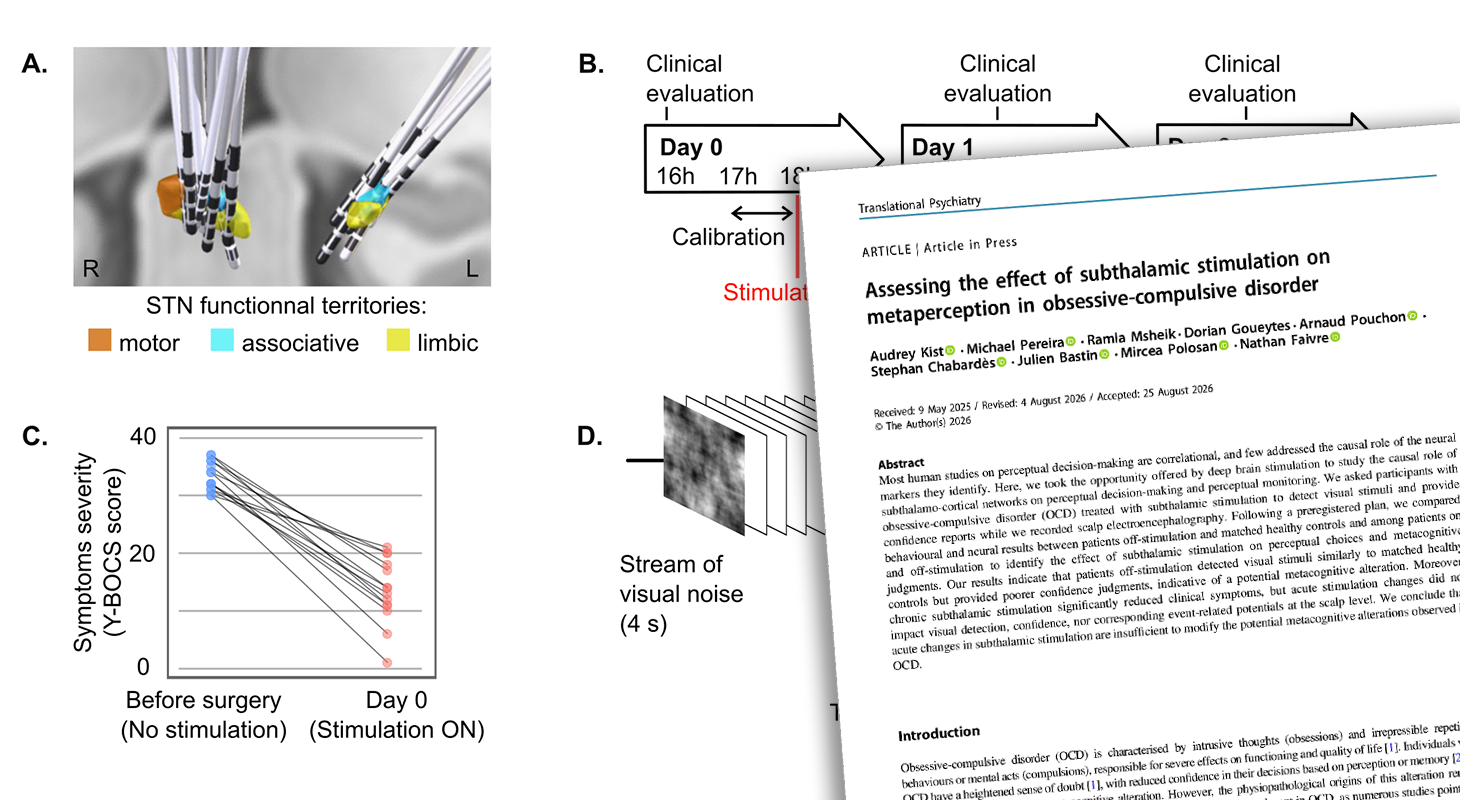
Doubting what we have seen, what we have done, or a decision we have just made: doubt is a prominent feature of obsessive-compulsive disorder (OCD). A study conducted at the Grenoble Institute of Neuroscience suggests that this doubt may not result from poorer visual perception, but could instead be linked to altered metacognition, the ability to evaluate one’s own perceptions.
Obsessive-compulsive disorder (OCD) is characterised by intrusive and persistent thoughts, known as obsessions, which may be accompanied by repetitive behaviours or actions, known as compulsions. OCD is often associated with considerable doubt: Did I lock the door properly? Did I perform this action correctly? Can I trust what I have just seen or done?
“OCD is sometimes described as the disease of doubt,” explains Audrey Kist, researcher at the Grenoble Institute of Neuroscience (GIN) and first author of the study. “An interesting question, therefore, is: why do people check? Is it because they actually perceived something incorrectly, or because there is a problem with the confidence associated with that perception?”
Seeing… then evaluating what we have seen
Audrey Kist and her colleagues asked 14 patients with severe OCD, treated with deep brain stimulation, to perform a visual perception task and compared their performance with that of 18 control participants.
During the experiment, participants viewed visual noise for four seconds, within which a face of varying contrast could briefly appear. They then had to report whether they had seen a face and indicate how confident they were in their response: not sure, moderately sure or very sure. Their brain activity was recorded simultaneously using electroencephalography (EEG).
This protocol enabled the researchers to assess both visual perception and the confidence participants placed in their own responses — in other words, their metacognition.
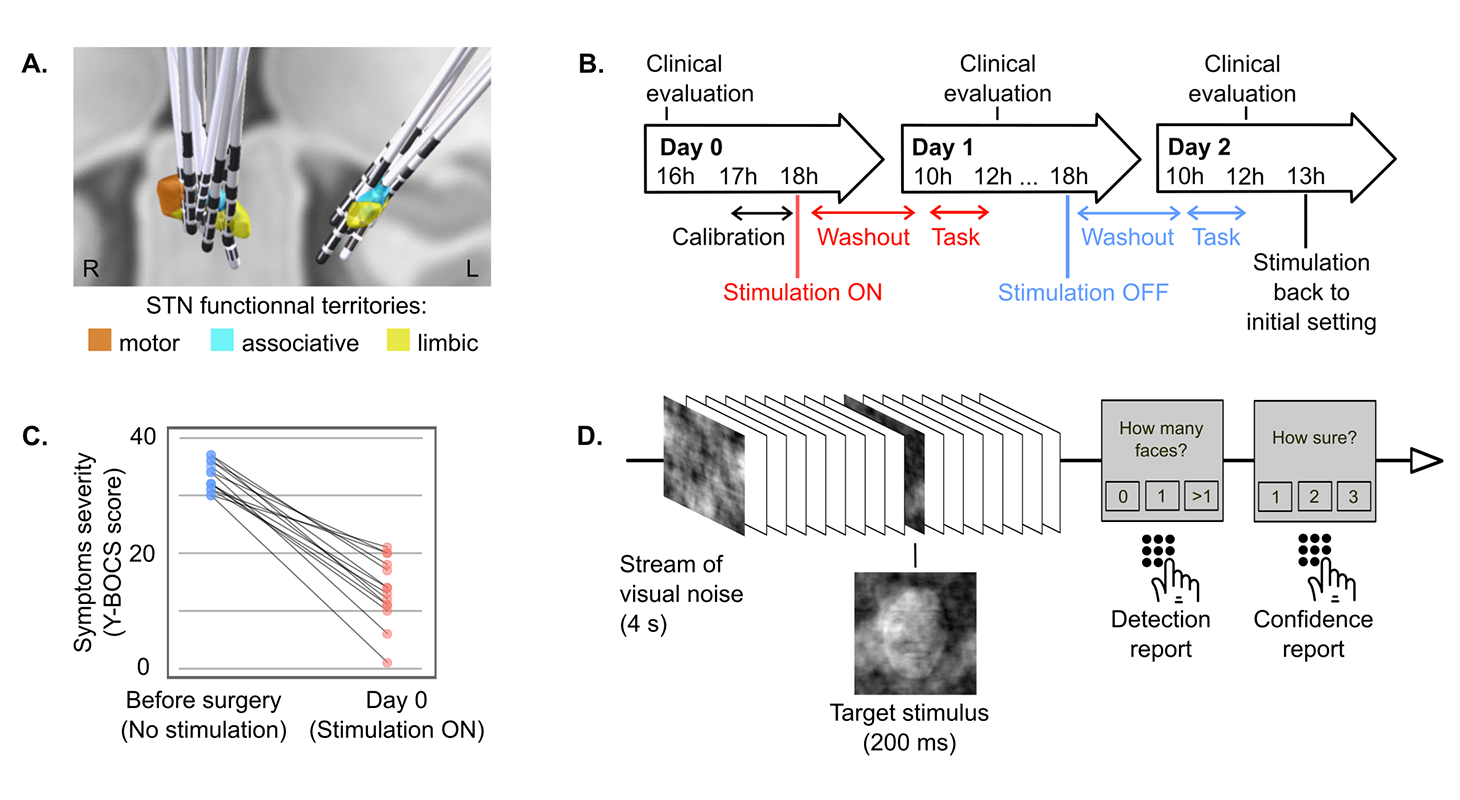
Experimental protocol of the study.
A. Location of the deep brain stimulation electrodes implanted in the subthalamic nucleus in patients with OCD. The colours represent its different functional territories. B. Experimental procedure. Patients performed the experiment with stimulation switched on and off, according to a randomised, double-blind protocol, after a 16-hour period without stimulation. C. Changes in symptom severity, assessed using the Y-BOCS score, between the preoperative assessment and the beginning of the study, after at least one year of chronic stimulation. D. Visual perception task. A face could briefly appear (200 ms) within visual noise presented for four seconds. Participants then had to report whether they had detected the stimulus and indicate their level of confidence in their response.
The results show that patients with OCD detected visual stimuli in a qualitatively similar way to control participants. Their doubt therefore does not appear to be explained by a poorer ability to perceive the stimuli.
However, their confidence in their responses appeared to correspond less closely to stimulus intensity than in control participants. The more perceptible a stimulus is, the more confidence in having seen it increases. This relationship was clearly observed in the control group, but appeared to be less pronounced in patients with OCD.
“This does not mean that patients simply lack confidence in their perceptions. It is more subtle than that. We are talking about altered metacognition, meaning a difference compared with the control group. An alteration, not a deficit,” emphasises the researcher.
What effect does deep brain stimulation have?
All 14 patients in the study, who had initially suffered from very severe OCD, had been treated with deep brain stimulation of the subthalamic nucleus for at least one year. This treatment, which modulates electrical activity in a brain region through implanted electrodes, had considerably reduced their symptoms: their mean score on the Y-BOCS* scale had fallen from 33.4 before surgery to 13.4 under chronic stimulation.
The researchers therefore investigated whether stimulation could also influence patients’ performance in the perception and metacognition task. In a randomised, double-blind protocol, each patient performed the experiment with stimulation both on and off, in a random order.
After sixteen hours without stimulation, no significant change in visual detection or confidence in the responses was observed compared with the stimulation-on condition.
However, this result does not rule out a role for the subthalamic nucleus in these processes.
“OCD symptoms can take a long time to reappear after stimulation is switched off,” explains Audrey Kist. In the study, symptoms that could be assessed over the short term had not significantly increased after sixteen hours without stimulation. Extending this period, however, could have exposed patients to a potentially very distressing return of their symptoms.
Towards a better understanding of the mechanisms of doubt
Published in Translational Psychiatry, this study therefore suggests that some of the mechanisms associated with doubt in OCD may be linked not to difficulty in correctly perceiving information, but rather to the way patients evaluate their own perceptions.
These findings open up several avenues for further research. In particular, the researchers propose investigating other brain circuits involved in metacognition, including cortico-subcortical loops involving prefrontal regions or the anterior cingulate cortex.
Reference :
Assessing the effect of subthalamic stimulation on metaperception in obsessive-compulsive disorder.
Kist A, Pereira M, Msheik R, Goueytes D, Pouchon A, Chabardès S, Bastin J, Polosan M, Faivre N.
Translational Psychiatry, 2026. DOI : 10.1038/s41398-026-04423-6.
* Y-BOCS (Yale-Brown Obsessive Compulsive Scale) : a clinical scale used to assess the severity of obsessive and compulsive symptoms.
Date
- Share
- Share on Facebook
- Share on LinkedIn